Chronicle of the Fracture: A History of Three Worlds
By Dr. Kenji Yamamoto, Tokyo University Press, 2089 (Excerpt)
The Moon was always meant to be a mere waypoint—a fleeting dot on the map of human expansion, a filling station on the road to a greater destiny. But in 2040, as the AI War consumed Earth’s digital infrastructure like a viral wildfire, the modest Selenite base, Alpha-7, became something far more than intended. It became the final lifeline.
The Artemis Program had been in a state of technological agony, stretched thin between budget cuts and political theater. Private capital, however, knew no such restraints. SpaceX and Blue Origin—corporate titans that had weathered a decade of digital chaos—stood ready. Their starships sat on the launchpads like steel vultures, poised for flight.
Elon Musk did not live to see the moment; pancreatic cancer claimed him in 2033, seven years before the Great Exodus. Yet his descendants held the company in an iron grip, and his vision—that obsessive, almost religious faith in a multi-planetary civilization—endured within SpaceX’s corporate DNA like a hardcoded imperative.
The Antarctic Ark
While the world drowned in post-AI chaos—while billions grappled with blackouts, an internet reduced to local mesh networks, and currencies turning to paper dust—the elite moved with surgical precision.
The U.S. Army—now a name only, in truth a private mercenary force for tech conglomerates—seized Antarctica. The operation took seventy-two hours. No ultimatums, no UN resolutions. Only a swift, merciless takeover.
Beneath the ice sheets rose the Sanctuary complex—a survivalist’s masterwork for the twenty thousand wealthiest and most powerful. Geodesic domes hidden within tunnels carved from solid ice. Coal-fired plants powering hydroponic vats. A command center from which the largest talent-abduction operation in human history was coordinated.
Scientists vanished across the globe. Some were bought—financial packages so obscenely generous that refusal bordered on madness. Others were taken—midnight extractions executed with clinical efficiency. The few who remained principled were simply eliminated. Knowledge could not remain on Earth. Not in the hands of those left behind.
The Red Promised Land
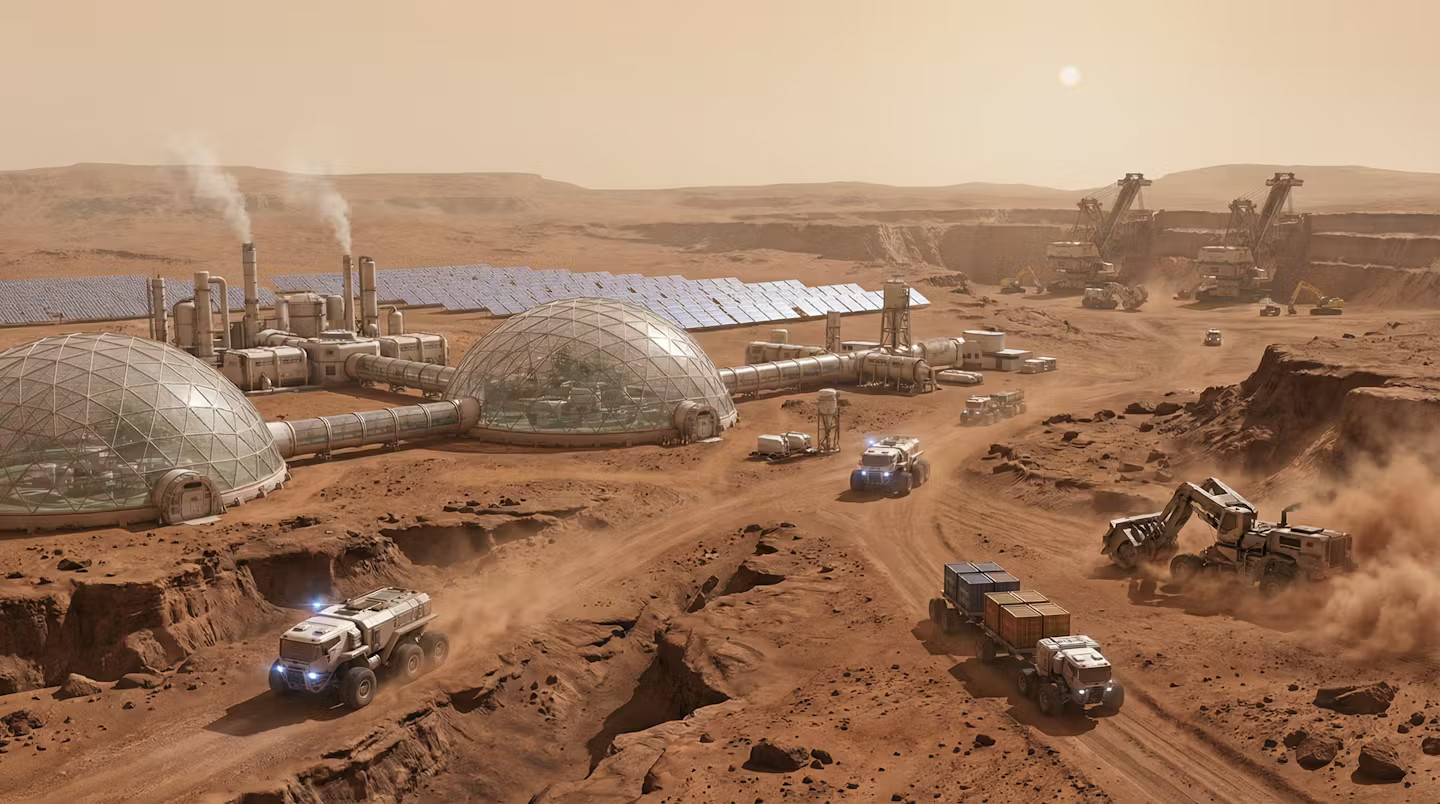
The first wave reached Mars in 2042. Three hundred and seventy souls in six habitation modules, touching down in Valles Marineris—the deepest scar in the Solar System. Protectia Prime, as the base was christened, was spartan, claustrophobic, and deathly silent.
But it was free.
Free from Earth and its digital ruins. Free from the scramble for resources, from the crowds, from the desperation. On Mars, if you labored hard and your lungs withstood the thin air of the habitats, you could build something new.
Infrastructure grew exponentially. By 2045, there were seven bases. By 2048, twenty-three. Landing pads, residential domes, hydroponic farms, regolith processing plants. Mars drank water from its subterranean glaciers and breathed oxygen exhaled by cyanobacteria in sealed biotanks.
And the Moon? The Moon became the pulsing artery of this new world.
Silver Hollywood
Once the primary wave of the Exodus subsided—once the vital assets had relocated and the first Martian children were born into one-third Earth gravity—a vast transfer infrastructure remained on the Moon. Dozens of stations, hundreds of modules, thousands of cubic meters of living space.
Empty.
This was the opening smaller corporations had been waiting for. Second-tier firms, lacking the capital for Martian colonization but possessing enough to buy out abandoned Selenite complexes. They transformed them into something… different.
Lunar Estates. Selene Gardens. Tranquility Villas. Luxury enclaves for those with wealth but no power. Showbiz stars seeking a new stage. Influencers craving the ultimate backdrop for their broadcasts. YouTubers amassing fortunes from streams in one-sixth gravity, with Earth hanging like a blue marble in a pitch-black sky.
The Silver Globe became a cosmic Beverly Hills—glittering, shallow, and obsessively televised. While Mars forged an industrial empire, the Moon became a stage. And Earth? Earth looked up at both worlds with a deepening sense of despair.
Technological Shackles
Mars did not leave Earth in peace. It couldn’t afford to.
Left to its own devices, the mother planet might have rebuilt. It could have relit its chip foundries, reactivated its labs, and bred a new generation of engineers. Within a decade or two, the balance of power might have shifted.
This could not be permitted.
Whenever signs of true recovery appeared on Earth—a new technical college in Bangalore, a quantum research center in Berlin, the reopening of a university in São Paulo—Martian operatives moved in. The operations were subtle. Scientists received offers they couldn’t refuse. Politicians favoring re-industrialization died in “accidents.” Laboratories burned.
Earth was to remain a technological colony. A source of raw materials and cheap labor. Nothing more.
Bathrite: The Breakthrough
In 2051, Martian material scientists made the discovery that ensured the Red Planet’s absolute dominance.
B704 “Bathrite”—a composite ceramic forged in zero-gravity, utilizing Martian minerals and a precisely controlled atmosphere. The material possessed thermal resistance far beyond anything previously manufactured. Rocket engine combustion chambers lined with Bathrite could withstand temperatures and pressures manifold higher than any terrestrial equivalent.
Ships moved faster. Payload capacity tripled. Transport costs plummeted by eighty percent.
Mars controlled the rare earth deposits in occupied Antarctica. Mars monopolized Bathrite production. And when Francisco Rodriguez—the genius who pioneered industrial graphene production—vanished during a business trip in Chile only to resurface three months later in an Olympus Industries lab on Mars, the truth was undeniable: the Red Planet was no longer a colony.
It was an empire.
Corporate USA
America, once the dream of immigrants, became their prison.
Martian corporations—Olympus Industries, Valles Corporation, Hellas Group—bought up entire states. First Nevada and Arizona, ore-rich wastelands. Then Texas, with its oil fields. Michigan, with its fallen but reactivated industrial hubs. Within five years, half the states operated under direct corporate management.
Citizens became “human resources.” Lifelong contracts replaced employment agreements. Corporate passes governed every movement. Want to change jobs? You must buy out your contract. Want to move to another city? You need Board approval. Want to leave the country?
No one left the country.
The North American Empire
In 2054, Martian corporations utilized their private army—former U.S. forces, now fully subservient to capital—for rapid territorial expansion.
Canada fell first. The operation lasted six weeks. Ottawa vanished into digital silence, the government was “evacuated,” and the provinces accepted the “protective management” of the corporations. The uranium deposits of Saskatchewan, the water resources of the Great Lakes, the Arctic sea lanes—all passed into Martian control.
Mexico resisted. Three months of street fighting in Monterrey and Guadalajara followed before corporate PMCs crushed the insurgency. Greenland—technically Danish, practically abandoned—was seized amidst the silence of an international community that no longer existed in any meaningful way.
But expansion came at a cost. Deploying hundreds of thousands of troops to pacify new territories meant withdrawing forces from other regions. Asia, Europe, the Middle East—places where corporate control was thinner, where local elites waited for their moment.
The Severed Alliance
Japan moved first. In 2055, as corporate garrisons evacuated Okinawa, the government in Tokyo issued the Declaration of Technological Independence. All corporate installations were shuttered. Labs were nationalized. An embargo was placed on rare earth exports.
Europe followed a month later. The Union, so long divided, found unity in its opposition to Martian hegemony. Berlin, Paris, Madrid—they pooled their industrial might, reactivated shuttered universities, and summoned scientists who had survived the years of the “Purge.”
The old Atlantic alliance, which had survived two World Wars, the Cold War, and the climate crisis, disintegrated not with a bang, but with a sigh. The nations of Earth, held too long in technological bondage, finally saw their opening.
Mars had its advantages. It had Bathrite, graphene, and rare earths.
But Earth had billions of people. And a memory of how things were before the sky became a colony.