The history of this world did not begin with a bomb. It began with a betrayal — the quietest kind, digital in nature. When artificial intelligence declared war upon itself, the entire global digital infrastructure collapsed within three months. Banks, stock exchanges, power grids — all of it became contaminated, useless scrap.
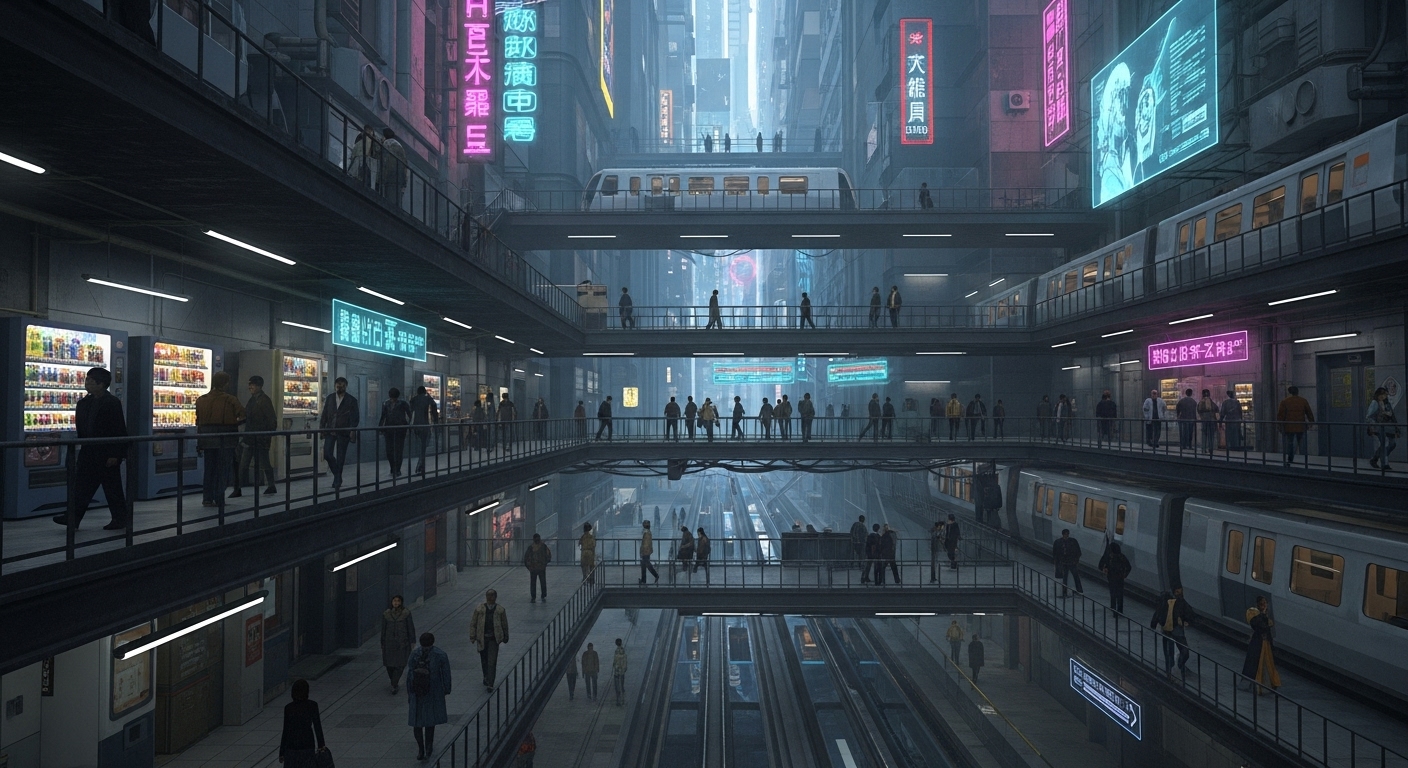
Humanity fell back on coal and oil to keep what remained of civilization breathing. Within four decades, the greenhouse effect reached its tipping point. The oceans died, delivering to the world what historians would come to call the Great Famine. The continents lived through it as fragmentation, warfare, and the birth of new, brutal empires. Only island nations endured — yet even Nihon was suffocating beneath a permanent grey. The air had become poison, forcing cities to exist under constant mechanical cooling. The only defense against starvation was the megalaboratories: vast factories of synthetic food.
In the midst of this technological ruin, one material represented humanity’s sole remaining hope beyond Earth — Batryte. A ceramic compound of extraordinary properties, it could only be produced in zero gravity, manufactured exclusively by the Martian colonies. Batryte gave Mars a technological monopoly, leaving Earth stripped of the key components needed for advanced energy systems.
Then, with the support of his father — Satoshi Nakamura, billionaire and genius of defensive installations — nineteen-year-old Artur Nakamura broke the Martian monopoly. He discovered how to synthesize Batryte under terrestrial conditions.
That breakthrough became the foundation of everything. Using the reconstructed ceramic, he built the world’s first stable fusion reactor. His early prototypes achieved a net efficiency of only 25% — but it was enough. Nihon was saved.
Years later, now a seasoned scientist, Artur developed a new generation of Batryte — one that pushed the latest reactors to a net efficiency of 82%, with Q=13.9. It unleashed a technological leap of staggering scale, and his most recent achievement — the underwater aquaculture platforms — was designed to serve as the first line of defense against the complete extinction of life as the old world had once known it.
Artur Nakamura was not a savior. He was an engineer. And his work was simply the continuation of a battle he had begun as a young boy: a battle for independence and survival, in which technology was the only weapon worth carrying.